Matter That Computes: What Programmable Materials Mean for Buildings and Cities
A four-meter tower built from thread and loose gravel, MIT's shape-shifting 4D-printed materials, and the decades-old dream of self-assembling robotic "catoms" — what programmable matter has actually achieved for architecture, and what's still speculation.
The Living Cities Editorial · Sep 8, 2026
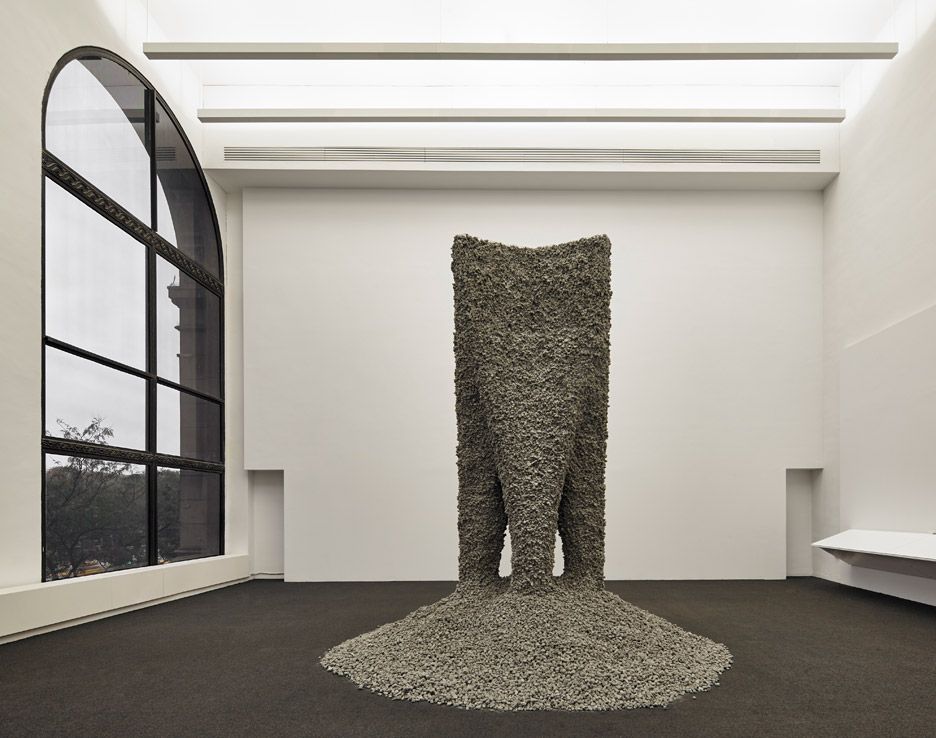
Rock Print, by Gramazio Kohler Research (ETH Zurich) and the Self-Assembly Lab (MIT), Chicago Architecture Biennial, 2015. Photo: Tom Harris, via Dezeen.
What is it?
Picture a pile of loose gravel, four meters tall, standing on its own with no mortar, no formwork, and no steel — held together only by a thread that a robotic arm laid down, one looping pass at a time, guided by an algorithm calculating exactly where tension needed to meet compression. That structure was built, not imagined: it stood at the Chicago Architecture Biennial in the winter of 2015, a collaboration between Gramazio Kohler Research at ETH Zurich and the Self-Assembly Lab at MIT. Its name, Rock Print, describes the process as much as the object — printing, in the sense of an algorithm directing material placement, applied to something as ordinary as crushed stone.
Rock Print sits inside a broader research territory usually called programmable matter: materials and modular systems designed so that shape, configuration, or behavior isn't fixed at the moment of manufacture but can be specified, changed, or computed afterward. It's a term borrowed from computer science — the idea that a substance could carry "software" the way a computer does — and it now spans a surprisingly wide range of real and speculative work, from a hobbyist-scale robotic cube that flips itself into new shapes to a decades-old, still largely theoretical vision of swarms of millimeter-sized robots called catoms. This article maps that range honestly: what has actually been built and demonstrated, what is a working laboratory prototype, and what is still, by any fair reading, speculation — and asks what any of it might mean for how buildings and cities could someday be assembled, reconfigured, or taken apart.
"Programmable matter" is not one technology but a family of research approaches that share a goal: giving physical material the capacity to change its own form, properties, or configuration according to a program, rather than requiring a person to reshape it by hand each time. Three broad approaches recur across the literature, and they matter architecturally in different ways.
The first is modular self-reconfiguring robotics — discrete physical units (cubes, spheres, or other repeating modules) that can connect, disconnect, and rearrange themselves into different overall shapes. Carnegie Mellon's long-running Claytronics project, developed with Intel and led by the late Seth Goldstein, is the most ambitious version of this idea: millimeter-scale spherical units called "catoms" (claytronic atoms) that would electrostatically latch together and move relative to one another to form and reform arbitrary shapes. A more recent, working example is MIT CSAIL's ElectroVoxel, led by PhD researcher Martin Nisser: roughly 6-centimeter cubes that use embedded electromagnets, rather than motors, to pivot around each other's edges and reconfigure into new arrangements — demonstrated on an air table and in parabolic zero-gravity flights, aimed initially at space structures.
The second approach is digital materials and discrete assembly, associated with Neil Gershenfeld and MIT's Center for Bits and Atoms. Rather than shape-shifting robots, this line of work treats construction itself as assembling many identical, simple, computationally trackable units — an approach Gershenfeld has described as making "the bit" physical, so that a structure's design and its assembly instructions are inseparable. It's a less cinematic vision than Claytronics but arguably closer to how large reconfigurable structures could actually be assembled and disassembled at scale.
The third, and the one with the clearest architectural track record so far, is self-assembling and shape-changing materials — physical components engineered so that geometry, humidity-response, heat-response, or magnetic behavior does the "computing" instead of embedded electronics. This is the territory of MIT's Self-Assembly Lab, founded and directed by Skylar Tibbits, which coined the term "4D printing" for 3D-printed objects designed to transform over time when exposed to a stimulus such as water, heat, or vibration. Rock Print belongs to this third category, though it also draws on granular-material physics research from the University of Chicago and ETH Zurich.
How does it work?
Rock Print's method is closer to construction than robotics in the conventional sense. A custom algorithm — developed with granular-physics researchers Hans J. Herrmann and Falk K. Wittel at ETH Zurich, and Heinrich Jaeger and Kieran Murphy at the University of Chicago — calculated where a robotic arm should lay successive loops of textile filament. Layers of thread alternated with layers of loose granular material (aerated glass gravel, a foam byproduct) placed by hand, about two centimeters at a time. The thread doesn't glue the rocks together; it constrains them just enough that friction and interlocking ("jamming," in granular-physics terms) does the structural work. No adhesive, no formwork, and — notably — the whole four-meter structure could be taken apart and its materials fully recovered for reuse in a different configuration.
4D printing, the Self-Assembly Lab's better-known contribution, works differently: a multi-material 3D printer deposits both a rigid material and an "active" material — one engineered to expand, fold, or contract when exposed to a stimulus like water or heat. Because the two materials are combined in specific patterns at print time, the printed object holds an embedded set of instructions for how it will move once triggered, the same way an origami crease pattern encodes a fold sequence before anyone touches the paper. Tibbits described this method in a 2014 paper in the journal Architectural Design, and the lab has since applied it to prototypes ranging from self-tying shoelaces to a chair whose parts snap into their final position after being tumbled in water.
ElectroVoxel takes a more purely robotic approach: each cube contains ferrite-core electromagnets wrapped in copper wire around its edges, controlled by an onboard circuit board. By energizing specific electromagnets in sequence, one cube can be made to pivot around the edge of its neighbor — a maneuver the MIT team calls "wireless hinging," since no motor or physical joint is needed. Coordinating more than a handful of cubes into a target shape, however, requires simulation software to compute the sequence of magnet activations; the researchers note that manually planning these moves becomes intractable beyond a few units.
Claytronics, by contrast, remains substantially a design and simulation exercise. Its catoms were conceived as roughly one-millimeter spheres that would connect via electrostatic or electromagnetic forces and move by rolling or "hopping" relative to neighboring units, coordinated by algorithms distributed across thousands or millions of units. Building working catoms at that scale — with embedded power, computation, and actuation all fitting inside a millimeter sphere — has proven to be the project's central, largely unsolved engineering barrier.
Why does it matter for architecture?
Most building components today are designed, fabricated, and installed as one irreversible act: a beam is sized for its final load and stays that way for the life of the building; a wall is built to a fixed geometry. Programmable matter research asks what changes if that sequence isn't fixed — if a component's final geometry, its ability to be reconfigured later, or its capacity to disassemble cleanly for reuse, is designed in from the start rather than treated as an afterthought (or, more often, not treated at all, which is a significant reason construction and demolition waste is such a large share of material flows).
Rock Print is the clearest existing proof that this isn't purely theoretical at architectural scale: a real, four-meter, load-bearing-adjacent structure, exhibited publicly, built from ordinary granular material with no cement and fully recoverable at the end of its life. It doesn't reconfigure itself after construction — that's a meaningful distinction worth being honest about — but it demonstrates that computationally choreographed assembly of simple materials can produce structures that would be difficult or wasteful to build by conventional means.
The self-reconfiguring robotics research (ElectroVoxel, Claytronics) points toward a different and more speculative architectural possibility: components that don't just get assembled once by an algorithm, but continue to reconfigure themselves afterward, in response to new requirements — the modular, replaceable, reconfigurable building envisioned in the Adapt capability's own framing. No one has built anything at architectural scale that does this yet, and it's worth being direct about that gap rather than implying otherwise.
The Living Systems Connection
Adapt. This is the most direct connection, and it's explicit in this publication's own framework: programmable matter is named specifically under the Adapt capability, alongside modularity, reconfiguration, and replaceable components. Rock Print demonstrates algorithmically choreographed assembly of simple, reusable materials into a specific, disassemblable structure — a real (if small-scale and temporary) instance of construction designed around later reconfiguration rather than permanence. ElectroVoxel and Claytronics push the idea further, toward components that could keep reconfiguring after initial assembly — closer to the capability's fullest ambition, but so far demonstrated only at small robotic scale, not architectural scale.
Respond. The Self-Assembly Lab's 4D-printed materials — components that fold, expand, or change shape when exposed to heat, humidity, or another environmental stimulus — sit closer to Respond than Adapt, since the change happens on a short timescale in reaction to an environmental condition, similar in spirit to a climate-responsive shading system, even though the "actuator" here is the material's own engineered geometry rather than a motor. It's worth being precise about the distinction: Adapt is about a system's capacity to be reconfigured or repurposed over longer periods; Respond is about real-time behavioral change. Much of the Self-Assembly Lab's published work — self-folding furniture, water-activated textiles — is genuinely closer to the latter, even though "self-assembly" sounds like it should belong to Grow.
Where the connection is weaker, and worth naming rather than glossing over: none of the projects discussed here sense their environment in a meaningful way (they respond to a stimulus applied during testing, not ongoing environmental monitoring), none involve biological growth in the sense the Grow capability describes, and none currently operate as part of a larger connected urban system. The algorithmic control involved in Rock Print's fabrication and ElectroVoxel's reconfiguration is a genuine instance of computational design (which this framework files under Think), but that's a design-and-fabrication-time computation, not an operating building "thinking" — a distinction worth keeping clear.
Reality Check
Technology maturity varies enormously across the research discussed here, and treating it as a single category would be misleading.
Rock Print: EXPERIMENTAL. A real, publicly exhibited structure, but a one-off installation built for a biennial, not a repeatable construction method with any commercial deployment. The project's own framing is explicitly about proving a principle — recoverable, mortar-free granular construction — rather than delivering a finished building system.
4D-printed self-assembling materials: EXPERIMENTAL, with pockets of EMERGING. Most of the Self-Assembly Lab's published demonstrations (self-folding chairs, shape-changing textiles) remain lab prototypes or gallery pieces. A few concepts from this research territory have reached actual products outside architecture (self-lacing/tensioning footwear systems, for instance), which is worth noting as evidence the underlying material science works — but nothing has yet reached building-component scale as a certified, commercially available product.
ElectroVoxel: EXPERIMENTAL. Demonstrated on an air table and in parabolic zero-gravity flights — genuine hardware, genuine test results — but explicitly early-stage, aimed at space applications first, and by the researchers' own account, coordination becomes computationally intractable to plan manually beyond a handful of units.
Claytronics: SPECULATIVE, bordering on stalled. More than fifteen years after the project's most active period, functioning millimeter-scale catoms with embedded power, computation, and actuation have not been demonstrated; the research has functioned more as a long-range conceptual and algorithmic exercise (how would billions of simple units coordinate, if they existed) than as a hardware program with a near-term deliverable. It's frequently cited in popular coverage of programmable matter in ways that can blur the line between the concept and anything actually built — worth flagging plainly.
The "any tool from a paint can" and "desk that becomes a couch" scenarios that circulate in popular and futurist coverage of programmable matter are speculative extrapolations, not descriptions of demonstrated technology. They're useful for illustrating the long-term ambition of the field, and this article cites them as such, but they shouldn't be read as close to realization — the actual hardware challenges (power delivery, computation, and actuation all packed into sub-centimeter or sub-millimeter units, at costs and reliability suitable for millions of units) remain substantially unsolved.
Open questions for architecture specifically: durability and weathering of granular, thread-based, or shape-memory-polymer structures in permanent outdoor conditions; cost and speed at real building scale (Rock Print's fabrication combined robotic and manual steps and took considerable time for a modestly sized installation); and — as with mycelium composites — the absence of any building-code pathway for material systems whose defining feature is that they don't have one final, fixed geometry.