Phillipsite and Al-tobermorite mineral cements produced through low-temperature water-rock reactions in Roman marine concrete
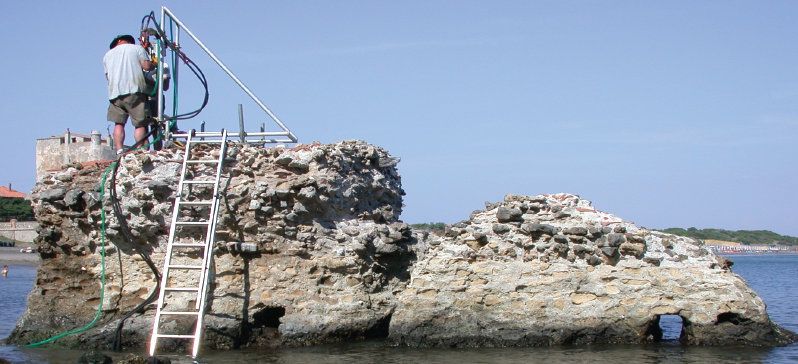
Portus Cosanus, Orbetello, Italy — the Roman marine concrete pier examined in this study. Photo: J.P. Oleson, via Berkeley Lab.
What mineralogical processes explain the exceptional long-term durability — and apparent strengthening over time — of ancient Roman marine concrete structures (harbor piers and breakwaters) exposed to continuous seawater contact for roughly two millennia?
FindingsUsing drill core samples and synchrotron X-ray microdiffraction, the researchers found that seawater percolating through the volcanic-ash (pozzolanic) binder of Roman marine concrete triggers slow, low-temperature growth of aluminous tobermorite and a related zeolite mineral, phillipsite, within the material's pore structure and existing microcracks. These platy, interlocking crystals reinforce the cementing matrix over time, increasing resistance to brittle fracture — meaning some Roman marine concrete plausibly becomes more resistant to cracking with age, rather than progressively degrading, a rare property among construction materials.
LimitationsThe mechanism is specific to a particular volcanic-ash binder chemistry in constant seawater exposure over centuries-long timescales — it is not a general property of Roman concrete, and modern reproduction depends on both access to comparable pozzolanic materials and validating whether the process can be meaningfully accelerated or replicated outside of a multi-decade natural timescale. The paper does not address modern reinforced concrete's dominant failure mode (steel corrosion), since Roman concrete of this kind contained no steel reinforcement at all.
Living Cities RelevanceA key historical precedent for The Living Cities' Explore article on self-healing concrete — direct evidence that a construction material can improve structurally through ongoing interaction with its environment, distinct from (and easily conflated with) modern bacteria-based self-healing concrete research.