Concrete That Heals Itself: What Rome, Bacteria and Algae Have in Common
Roman harbor concrete has endured constant seawater for two thousand years while modern reinforced structures fail within decades — and three distinct threads of research, from ancient mineralogy to living bacteria to algae-grown limestone, are separately asking whether concrete could repair and renew itself instead of just wearing out.
The Living Cities Editorial · Sep 10, 2026
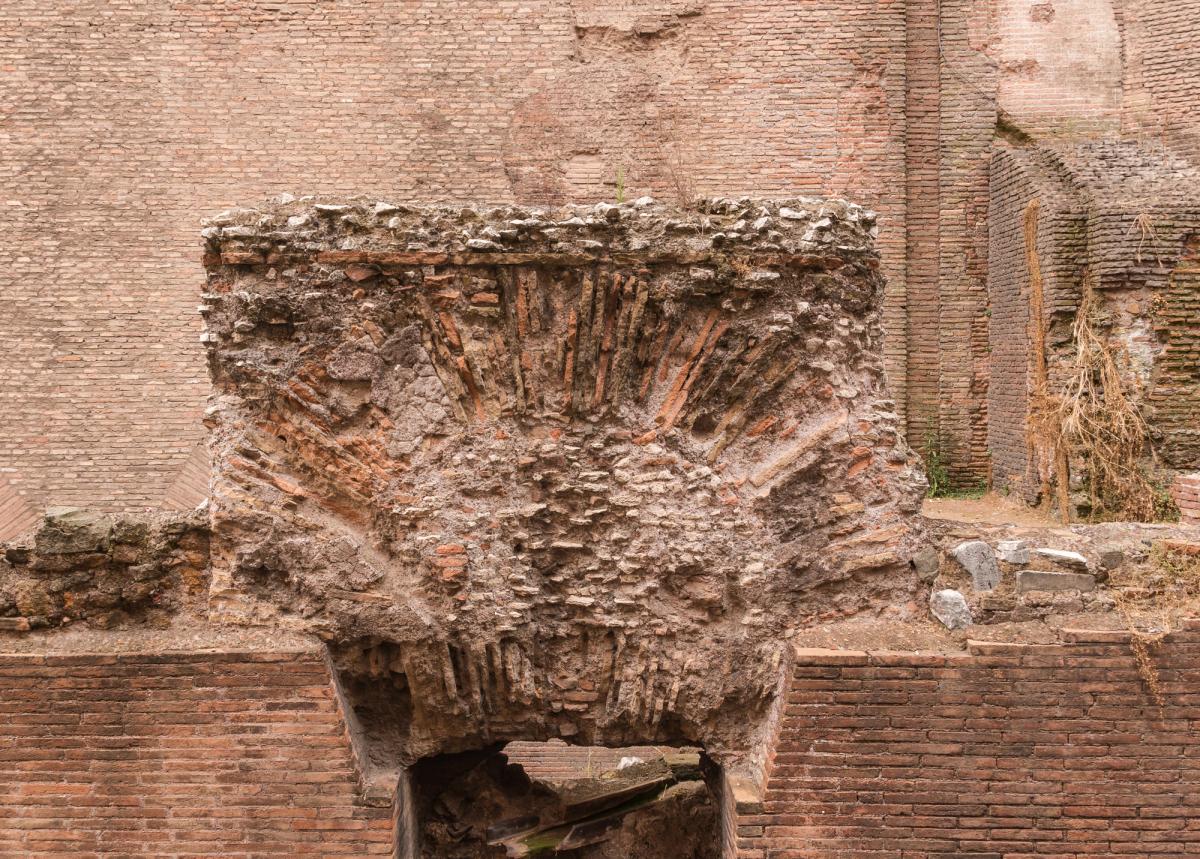
Roman concrete construction at the Pantheon, Rome. Via Wikimedia Commons.
What is it?
There are three distinct bodies of research and technology behind the idea of "living" or self-healing concrete, and it's worth being precise about which claim belongs to which.
Roman concrete's durability has been explained by at least two separate, unrelated mechanisms, depending on which structures are being studied. A 2023 study led by Admir Masic's group at MIT, published in *Science Advances*, examined land-based Roman concrete (from structures like the Privernum city wall) and identified "lime clasts" — small, reactive lumps of unmixed calcium — as a deliberate byproduct of a technique the researchers call hot mixing, using quicklime rather than pre-slaked lime. When cracks later form and water reaches these clasts, they react, dissolve, and recrystallize as calcium carbonate, filling the crack. A separate, earlier line of research led by geologist Marie Jackson (then at UC Berkeley, now University of Utah), published in 2017 in *American Mineralogist*, examined Roman marine concrete specifically — harbor structures exposed to constant seawater — and found something more striking: seawater percolating through the material's volcanic-ash binder triggers the slow growth of a mineral called aluminous tobermorite, along with a related zeolite, phillipsite, which interlock and actually reinforce the concrete's matrix over centuries. In other words, some Roman marine concrete plausibly gets more resistant to cracking over time, not less — a genuine rarity in construction materials, and the direct ancient precedent for architects now asking whether concrete can behave less like a depreciating asset and more like a system that maintains itself.
Bacteria-based self-healing concrete is a modern, biologically active technology, not an ancient one — pioneered by microbiologist Henk Jonkers and civil engineer Erik Schlangen at Delft University of Technology (TU Delft) starting in the mid-2000s, and commercialized through the TU Delft spin-off Basilisk. Dormant bacterial spores (typically from the Bacillus genus, chosen for their ability to survive concrete's highly alkaline environment) are mixed into the concrete along with a food source. When a crack forms and water and oxygen reach the spores, the bacteria activate, consume their food source, and metabolically produce limestone (calcium carbonate) that fills the crack from within — genuinely closer to a biological repair process than a chemical one.
Algae-grown limestone addresses a different part of the problem entirely: not how concrete repairs itself, but how its most carbon-intensive raw ingredient is made in the first place. Led by Wil Srubar at the University of Colorado Boulder's Living Materials Laboratory, and commercialized through the spin-off Minus Materials, this research uses coccolithophores — microalgae that naturally build calcium carbonate shells through photosynthesis — to grow limestone biologically, using sunlight, water, and captured CO₂, as a substitute for the quarried limestone that Portland cement production depends on.
How does it work?
Roman hot-mixed concrete's self-healing, per the MIT-led study, depends on using quicklime (calcium oxide) directly in the mix rather than pre-slaking it into a paste. This produces the reactive lime clasts, which act as a built-in, slow-release source of calcium that can respond to new cracks indefinitely, long after the structure was built. Roman marine concrete, per Jackson's research, works through an entirely different pathway: the volcanic ash (pozzolana) in the mix reacts with seawater over years and decades, dissolving and reprecipitating as tobermorite crystals that grow into the material's pore structure and existing microcracks, physically interlocking and stiffening the matrix — a process closer to slow, beneficial mineral weathering than to a repair mechanism as such.
Bacterial self-healing concrete works on a fixed timeline rather than a centuries-long one. The bacterial spores and their nutrient source (commonly calcium lactate) are protected inside the concrete — often encapsulated, since the spores need to survive the pour and then remain dormant until needed — until a crack opens a pathway for water and oxygen. Activated, the bacteria multiply and metabolize the nutrient source, and calcium carbonate precipitates as a metabolic byproduct, sealing the crack. Research groups, including a University of Bath team led by Professor Kevin Paine and Dr. Susanne Gebhard, have also developed variants using psychrotrophic bacteria (sourced from local limestone caves) specifically selected to remain active at low temperatures around 5°C, addressing one of the technology's practical limits — most bacterial strains used in earlier versions worked best closer to room temperature.
Algae-grown limestone works by cultivating coccolithophores in engineered bioreactor conditions — sunlight, seawater or freshwater, and CO₂ — where the microalgae build calcium carbonate shells as a natural part of their life cycle, the same biological process that has been forming limestone deposits in the ocean for hundreds of millions of years, compressed into an industrial timeframe. The resulting biogenic limestone can substitute for quarried limestone in Portland cement production. Because the algae absorbed CO₂ to build the shells in the first place, and cement manufacturing later releases CO₂ when limestone is burned into clinker, the process can be close to carbon-neutral for the portion that's burned — and genuinely carbon-negative for any biogenic limestone used as unburned filler material, since that carbon stays locked in the material.
Why does it matter for architecture?
These three threads matter for different, complementary reasons, and conflating them would overstate what any single one has actually achieved.
The Roman research matters because it reframes what "durable" means for a structural material — not simply "resistant to degradation," but, in the marine case, capable of a slow, beneficial chemical response to its environment that modern reinforced concrete, with steel that corrodes and expands destructively when water reaches it, cannot replicate. It's a genuine precedent for the idea that a building material could interact productively with its environment over centuries rather than merely resisting it until failure.
Bacterial self-healing concrete matters for a more immediate, practical reason: the dominant failure mode of modern reinforced concrete is corrosion of the embedded steel once water reaches it through cracks, and self-sealing cracks directly interrupt that pathway. The real-world projects reviewed for this article — a Netherlands railway underpass, hospital balconies, a bus lane, tunnel repairs — consistently pair the technology with a second, compounding benefit: because the concrete is expected to sustain and heal minor cracking on its own, engineers can specify less steel reinforcement (Basilisk's own project list and independent coverage cite reductions in the 30–40% range across several projects), which reduces both material cost and embodied carbon.
Algae-grown limestone matters for a third, distinct reason: cement production is one of the largest single industrial sources of global CO₂ emissions, primarily from the chemical decomposition of limestone during clinker burning. Growing the limestone biologically doesn't eliminate that chemistry, but it changes the carbon accounting of the input material — and, notably, this is the one thread of the three that isn't about self-healing at all. It's a separate, complementary idea: that concrete's ingredients, not just its repair mechanism, could come from a grown biological process rather than an extracted mineral one.
The Living Systems Connection
Grow. This capability's own framework definition names self-healing materials, living materials, biofabrication, and engineered biological materials directly — and bacterial self-healing concrete is about as literal an example as exists in current building-materials research: living organisms, embedded in an otherwise inert material, performing a repair function through their own metabolism. Algae-grown limestone extends the same capability into the supply chain rather than the repair cycle — an ingredient that is cultivated through a biological growth process (photosynthesis, shell formation) rather than mined. Roman concrete's self-healing is a harder case, and worth being precise about: it is a chemical and mineralogical process, not a biological one, so it illustrates the goal of self-repair without itself being a Grow-capability technology — a useful reminder that "self-healing" and "living" are not synonyms, even though they're often used interchangeably in popular coverage.
Regenerate. Algae-grown limestone connects clearly here too: replacing a quarried, carbon-intensive ingredient with a cultivated, carbon-capturing one is a direct instance of a building material participating in a resource cycle rather than only depleting one. Bacterial self-healing concrete has a real, if more indirect, Regenerate connection through reduced material consumption over a structure's lifetime — less reinforcement steel, fewer repair interventions, a longer service life before demolition and replacement — even though the concrete itself isn't capturing carbon the way the algae-limestone process is.
Where the connection is weaker: none of these three technologies Sense, Think, Respond, Adapt, or Connect in any meaningful sense. Bacterial self-healing concrete doesn't monitor its own condition or make any decision — it responds passively and only locally, exactly where water physically reaches a crack, which is a real mechanism but a narrow one. It's worth noting that some of the same TU Delft research groups working on bacterial concrete are also developing separate "self-sensing" concrete technology that can detect damage electronically — a genuinely different, Sense-capability technology that shouldn't be conflated with the bacterial self-healing work just because both come out of similar labs.
Reality Check
Roman concrete research: this is settled archaeological materials science, not a proposal. Both the hot-mixing and marine-mineralization mechanisms are published, peer-reviewed findings about structures that already exist and have already survived roughly two millennia — there's no maturity classification needed for the historical claim itself. What remains genuinely open is how directly these mechanisms translate to modern construction: Roman concrete used very different aggregates (volcanic ash, often unavailable at scale in the same form today), achieved much lower compressive strengths than modern structural concrete, and contained no steel reinforcement to protect from corrosion — the single biggest driver of modern concrete's need for repair in the first place. The MIT-led team's own modern lime-clast formulations, described as demonstrating "self-healing potential," should be read as EXPERIMENTAL — an early proof of concept, not a specified, buildable modern material yet.
Bacterial self-healing concrete: EMERGING. This is the most mature of the three threads discussed here — commercialized (Basilisk, and other producers), used in real, named, dated projects (a Netherlands railway underpass, a hospital, a bus lane, tunnel and bridge repairs), with independently documented performance figures from those projects. It is not, however, a mainstream default in construction — it remains a specified, premium option chosen project-by-project, generally in applications with high durability value (infrastructure, healthcare, transit) where reduced maintenance and lifetime cost can justify a materials premium. Its self-healing is also narrow in scope: it seals fine cracks (typically well under a millimeter), not structural failures, and healing timelines and reliability vary with temperature and moisture availability, which is precisely why ongoing research (like Bath's cold-tolerant bacterial strains) is still addressing real, unresolved gaps rather than refining a finished product.
Algae-grown limestone: EXPERIMENTAL. Minus Materials has produced only small quantities to date and is still working through the economics of scaling production affordably — the company's own stated strategy of subsidizing limestone production with higher-margin biofuel, food, and cosmetics products from the same microalgae is itself a sign that cost-competitive limestone production at cement-industry scale has not yet been demonstrated. The claimed carbon-negative outcome is real in principle but conditional: it depends on how much of the biogenic limestone ends up burned into clinker (which releases the stored CO₂ again) versus used as an unburned filler (which keeps it locked away) — a distinction worth watching for in any future coverage that cites a single "carbon-negative" headline figure without that qualifier.
A caution about "gets stronger with age" as a general claim. It's tempting to generalize from Jackson's marine-concrete findings ("Roman concrete gets stronger in seawater") to a broader claim that self-healing concrete generally improves with age. That's not quite right: the Roman marine mechanism is a one-directional mineral-growth process specific to a volcanic-ash binder in constant seawater contact over centuries; modern bacterial self-healing concrete restores lost integrity after damage, which is a genuinely different (and more limited) claim than gaining strength beyond its original design condition. Keeping these distinct matters for accuracy, even though both are legitimately remarkable.

