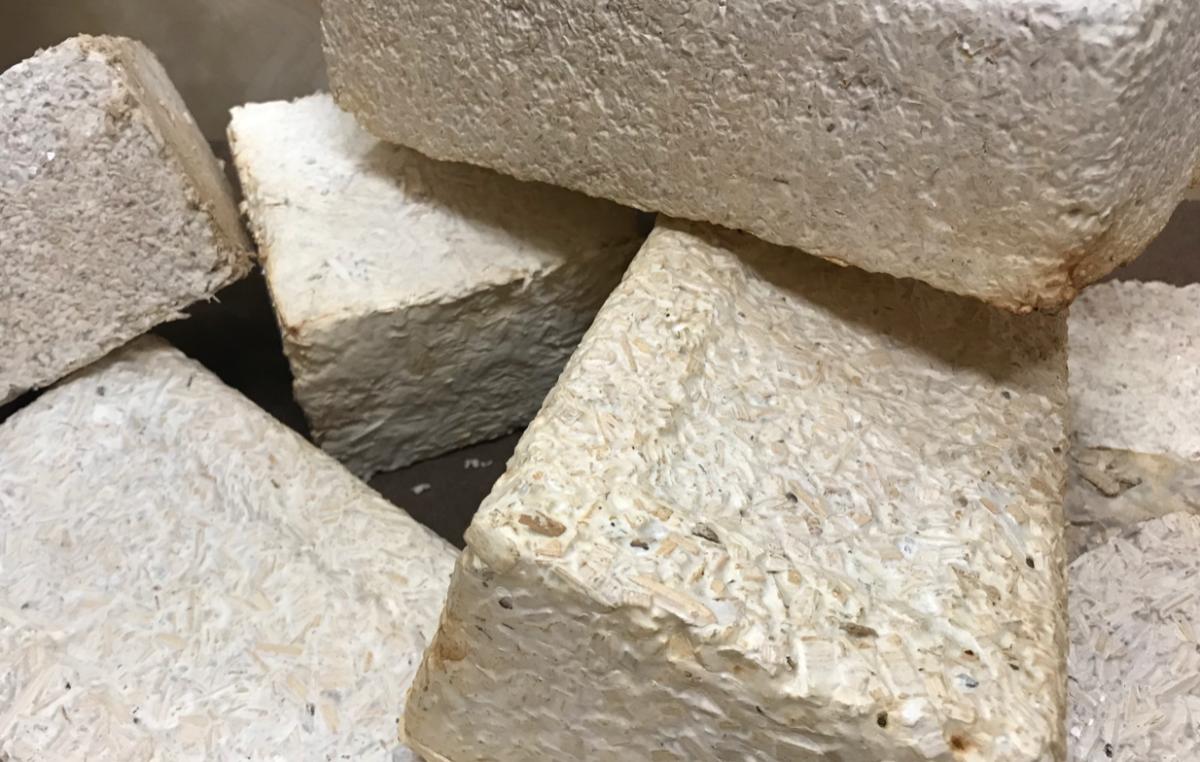
Illustrative image, not a figure from this paper: mycelium-based bricks grown from yard waste and wood chips, from NASA's fungal-habitat research. Credit: NASA.
Can mycelium bricks insulate a building as well as the synthetic materials — mineral wool, expanded polystyrene — that dominate the market today?
FindingsBricks grown from three basidiomycete fungi (Oxyporus latermarginatus, Megasporoporia minor, Ganoderma resinaceum), originally isolated from trees in Egypt's Nile Delta, on wheat straw reached densities of roughly 51–62 kg/m³ and thermal conductivities between 0.078 and 0.081 W/mK. That beats some other bio-based composites tested in the same paper, but is still roughly twice as conductive — a worse insulator — than expanded polystyrene (0.029–0.039 W/mK). The fungus that broke down the most straw (Ganoderma resinaceum) also produced the least thermally consistent block, suggesting a trade-off between digestion speed and block quality.
LimitationsThe authors describe the work as preliminary: their dual-needle transient-probe thermal method has calibration limitations given the material's high porosity, and they call for steady-state testing (guarded hot plate or hot box methods) before the conductivity figures can be considered fully validated. The study also does not address fire performance, moisture behavior, or long-term durability.
Living Cities RelevanceA rare laboratory-controlled data point on mycelium composites as insulation specifically — distinct from, and more measured than, high-profile structural demonstrations like Hy-Fi, which this paper does not test.
